Sunday, 20 May 2012

Breathe:
Head dress:


The head dress was the last part of the Breathe project I completed. Bethan Francais constructed the example head dress that we followed to create our head dresses. Me and Naomi Bonner worked together to create the headdress so the process didn't take as long to make, this was very important due to tight construction restrictions.
To start we needed to cut out various circle shapes out of blue foam in the work shop. This the base shape we working with to create the horns.
Once the circular shape were cut out the shapes were cut into on a slight angle to make the curve in the horn. Each shape needed to as similar as possible to make the pair of horns as similar as possible.
After the right shapes were cut out a super glue gun was used stick each layer together to create the base horn shape.

First Stage:


Once the horns were at this stage we needed to file down the base shape to create a smoother shape of horns. It didn't need to be perfectly shaped as the beaten weathered look needed to be incorporated into all areas of the costume. Sand and PVA was then painted on top to create the same texture as the sash as it is all for the same finished garment.

Second stage:


This is what the sanded down horn looked like, from this point I needed to layer up the the paint much in the same way as the sash was painted. The colours were slightly different, but the final finish was really effective. Once the base colours were dried the final finish was to brush over very lightly with a gold paint to high light the raised rough sand, it really highlighted the idea of a weather beaten head dress.

Third Stage:


Wire was then placed through the horn so that the wire could be poked through a hat and attached. Once the horns were attached and fully secured plasterzote was used to cover the wire on the inside of the hat and around the rim of the hat to make it a lot more comfortable for the performer to wear. 
Once the horns were in the right place and the hat was made comforatble strips of various fabric were hand tacked onto the hat to decorate the baseball cap. The fabrics used are all the same or in the similar style to the ones that were used in the cloaks to tie everything together.

Final Costume piece:


Wednesday, 16 May 2012

Breathe: 
Rock Sash:


Another section of this project that needed to be created as part of the first costume was a 3D sash that would be attached to the front of the cloak and then attached to the hip of the base costume.

To create this I needed to be experiment with expandable foam. This is a substance that sticks itself to the fabric and then expands a lot.
As I sprayed the expandable foam onto the calico base fabric I shaped it into a slight curve so it would   curve around the body.
Once it had fully expanded and dried the foam was sanded down to create the weathered worn down look of sea rock.

This is what the base of the sash just covered in sand to give it some extra texture:


Once the sash had dried it needed to be worked into with paints to create the look of rocks. Several different layers of paints were used to build up the right look. The sand made the paint drag across surface which gives its a really good weathered look.
Lighter paints were used to highlight the higher areas.

Below is a final image of the sash:


Once Upon a Tease:


So now the final corset designs have been chosen, our supervisor Naomi Bonner sourced all the fabrics that had been chosen by the company.
A basic pattern was chosen for the 3 light pink corsets, this was then adapted for the individual measurements we had for our dancer.
The full body corsets needed to be draped on the stand separately as they connect all the way under the body so the patterns were made slightly differently.
Having not made a corset since the beginning of uni it was quite interesting to see how much I remember. Due to time constraints we adapted the making of the corset to be easier for us to construct and also change after the fittings.


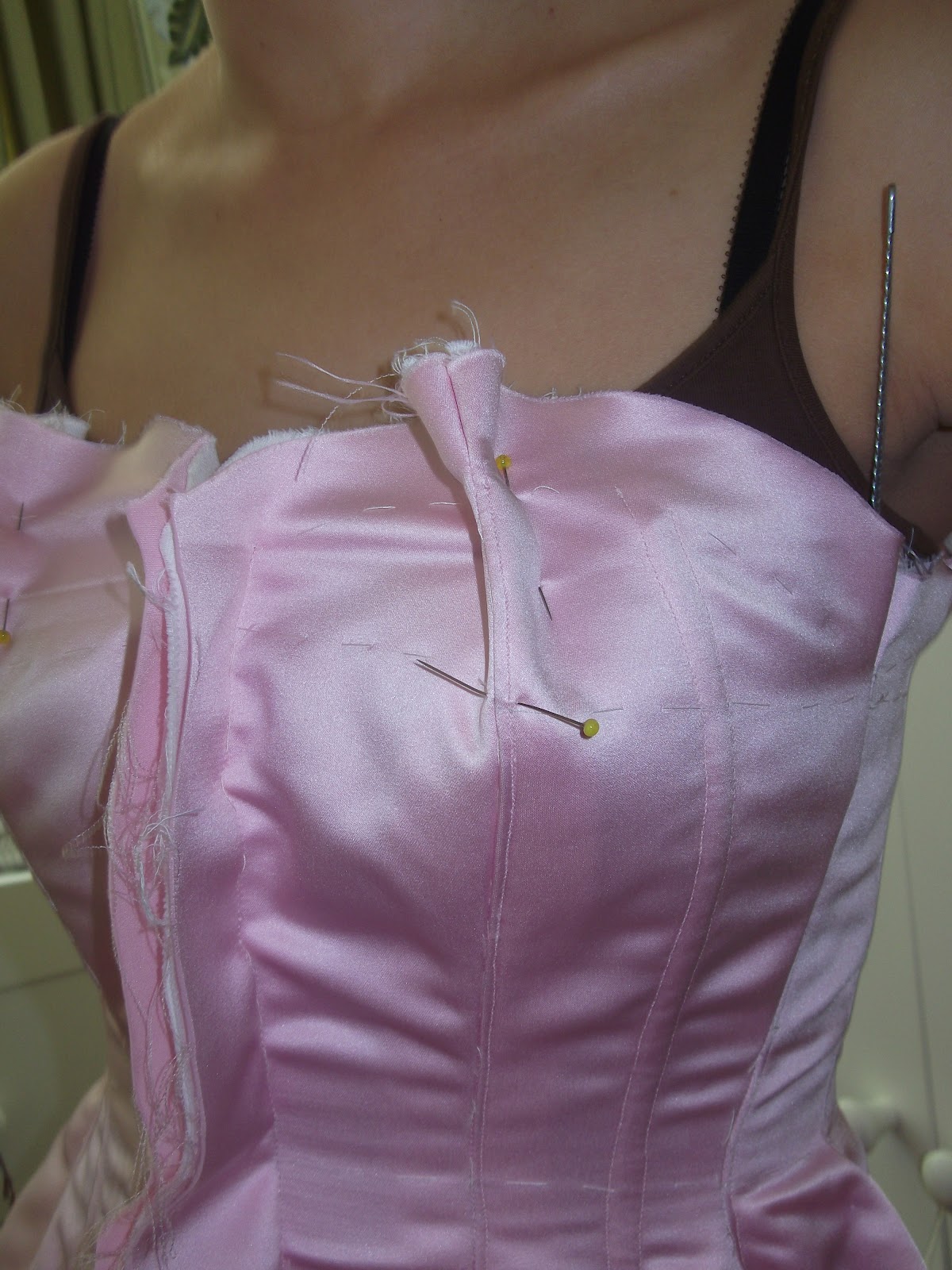
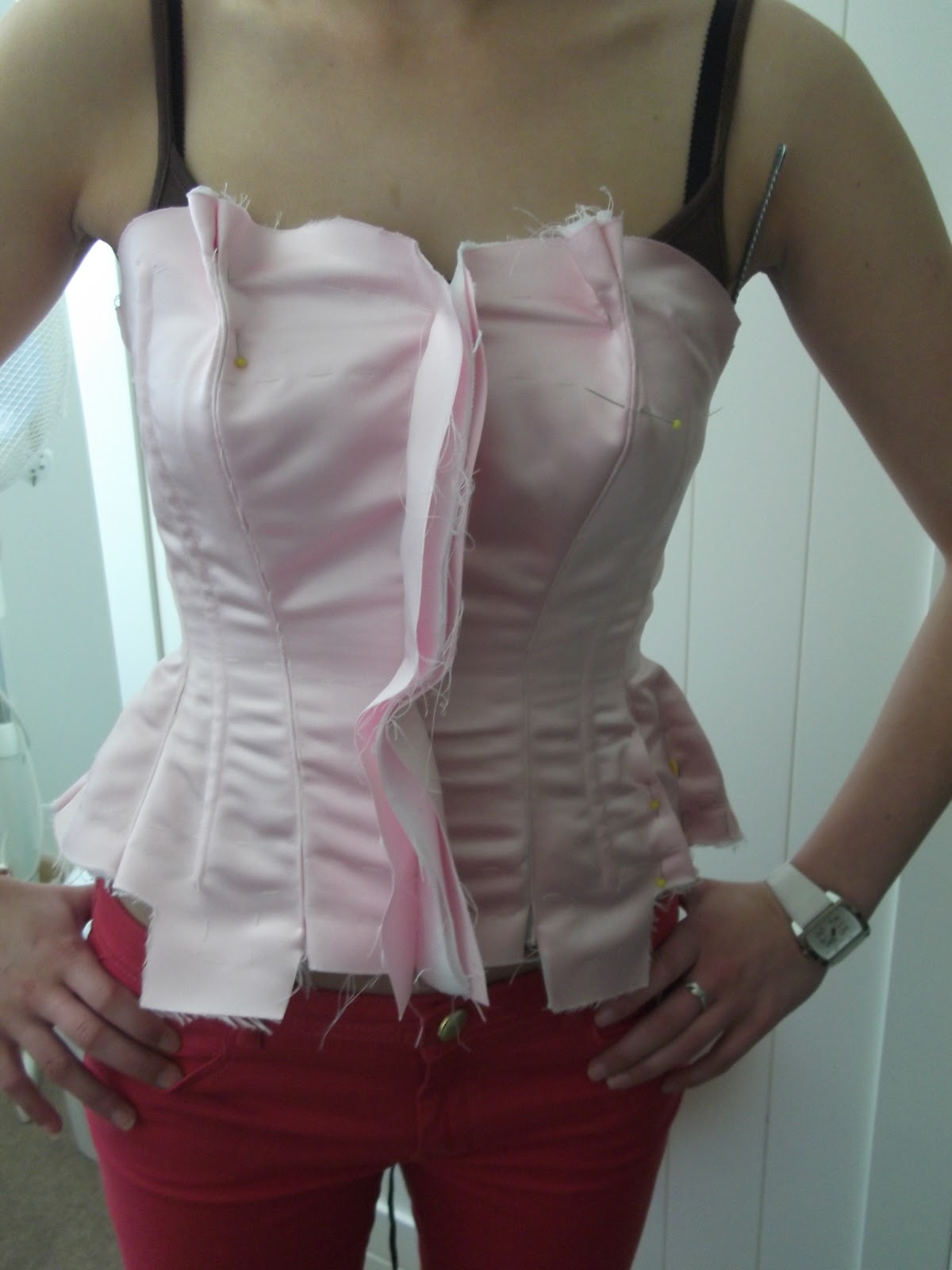
A week was spent getting the very basics of the corsets put together for a fitting on Friday 11th and  Sunday 13th.

Fitting photos:
 . A lot of gaping at bust
- Seam A: 1.75 off either side from design line
- graduate down to bust line
-Seam B: 1.5 off only one side- side without boning chanel

 . Too much gaping around the hip
- Seam C: take in 3.5 cm either side of hem line and graduate up to waistline 

. Here the boning panels were not attached correctly to the back of the corset- when actually constructing the boning channels in the corset they will sit into pink so the gap will be much further apart.

The model was quite a lot smaller than the corset in places, the shape and fit of a corset is the most important thing to consider when making a corset. These corsets especially as they are being made for a burlesque production need to make the model feel as sexy as possible.

Sunday, 13 May 2012

Breathe:
Adaptation Cloak:


The second cloak I needed to produce was to be made from a fur coat that had been provided to the Breathe club already. I had to adapt this coat so that it would fit in with all the other cloaks that were being produced as part of the 'Hunters' collection.

As I had already made the first cloak the second cloak was a much quick process to reproduce. The shape of the original cloak was exactly what was wanted from the design that I was given so the first thing I concentrated on was the surface decoration. The same decoration was used on this cloak as the others so that all the cloaks would link together as a collection yet still retain the individuality of each of the makers.

From the design I had to change the decoration slightly. In the design the netting was only in one section, however when it came to adapting the coat there wasn't enough fur to cut the fur and put in the netting in the middle. After discussions with Kate we decided to add to parts of netting decoration, so there was less fur on the cloak than was originally designed. From an aesthetic point of view this was the only way to make the design work.

On the same way as I did on the first cloak, I used a embroidery foot on a domestic machine to create  circles on the fur to attach the decoration. This was a lot more difficult on this cloak than on the first because the fur was so much thicker so got caught up constantly on the foot.

Another problem with this cloak was the fact the fur was so different and shinny and new it took a while to blend in the two different textures of the netting with the fur. To over come this idea of just a block of netting then a block of fur, I carried on the circles  to decorate into the fur. This with the barnacles added onto the surface made the cloak flow a lot better.

After all the cloaks have been produced as a group we will come together to break down all the final costumes even more to really give the feel of weathered sea hunters.

Second Cloak finished:


Breathe: Adaption Cloak; Reflection:


Again with this section of Breathe it has been really interesting to be able to experiment an be more creative than in some previous projects that we have done.
Adapting the cloak was much more of a problem solving project as I did find it quite hard to get past the initial blocky look of the decoration on the fur as it looked to much like the original coat not like a hunter.
After putting the garment on the stand, I could see were the problem lay with the garment. The front edges of the cloak were far to neat and straight. From here I draped netting along the  front edge of the cloak to break up the front line. This made a huge difference to the final look of the garment.

Also because of the nature of the piece that the cloak would be in arm holes were created in the sides of the garment to make it much easier for the performer to wear and dance in.
A new popper is needed to secure the cloak at the front as the one originally in the garment was far to fiddly and insecure. This will have to be done at a later stage as the poppers could not be sourced at this time. The garments need to be easy for the children to dress them selves in as they will be doing it on their own.


Saturday, 12 May 2012

18th Century Waistcoat Reflection:


Looking back on what I did within this mini project I feel I learnt a lot. The construction process of this piece of work was hugely beneficial to me. I really wanted to create a piece I felt pleased with. I tried hard to create a crisp finished piece and tried to be as accurate as possible. I feel my construction skills have hugely benefited from working this way. Although there are areas that as still in need of further development I am pleased with my final outcome.


Time restraints are always going to be an issue with the industry I am going into but through this project I feel I am beginning to develop my speed as well as my accuracy.

Reflecting back on this piece of work, there are still areas I need to work on. The crispness of the finished edges of the waistcoat could be sharper, however the nature of the material I was working with did make this slightly harder as it was really soft and didn't create that sharp edge.
The decoration that was chosen for my waistcoat may not have been the most suitable. The button although very beautiful and matched the braiding decoration, were very heavy metal buttons. The moleskin fabric that I used to create the waistcoat is not very strong to support the weight of the buttons so the buttons may slightly pull the fabric.

I really enjoyed making the waistcoat and I am pleased with the final product


18th Century Waistcoat continued:


Through the last couple of weeks the waistcoat has taken great shape. In this making process I have been very precious with all my stitching lines. I wanted to create a final piece I would be proud of.
However this has meant taking longer on sections are re doing pieces, the extra time taken has been very worth while though.

In the construction of the waistcoat the first thing we had to do, after cutting out the fabric, was creating the pockets on the waistcoat front. This was a daunting thing to do as the first process as it meant snipping into your fabric to create the pocket mouth. If you do this stage wrong then the look of the garment will be ruined.
You had to be extremely careful with your measurements through this stage and also make sure everything matched on the other side of the waistcoat. It was an extremely fiddly process to get correct and on one half of my pocket the uprights of the pocket mouth were very slanted instead of upright.
I could either leave the pocket mouth like that and hope that with prick stitching that it would look better or I would have to cut out the front again.
Even though I lost time I cut out a whole new front of my waistcoat and re did the pocket. This was a great learning curve for me as it taught me the delicacy of costume making and a chance to re do my mistakes rather than just leaving them.

Once the pockets were assemble the waistcoat could be put together in its two half, the lining waistcoat and the front of the waistcoat, these processes were reasonable easy and came together well.

The next very time consuming aspect of the waistcoat was the decoration. Our tutor wanted the front of the waistcoats decorated as they would have been in the 18th century.
 However  in the 18th century waistcoats would have been heavy embroidered by hand which would just not have been possible for us.

Below are some examples of the embroidery of the time:


The decoration we hand stitched to our waistcoats was much less detailed than this. However within the short time scale we had to complete our garment a lot of care and time was needed to apply the braiding we were given. to make sure the braiding was straight and that the stitching we did to attach the braiding to the front of the waistcoat was as invisible as possible.
We took extra time on the braiding to make sure it was perfect, however this did cause us to take longer with the final construction of our waistcoat so we did not complete it on time.
The extra time we took with the braid made a hug difference to the final finished garment however so was worth the extra care.

Once the braiding was complete the waistcoat was easy to assemble the hems were stitched together, then we slip stitched the arm holes, the facing an the lining together, machine stiched the collar on an the slip stitched the lining to the collar.

The final touches were the buttons and button holes.

Below are the final image: